Question1: A OneConnect profile is applied to a virtual server. The LTM Specialist would like the client source IP addresses within the 10.10.10.0/25 range to reuse an existing server side connection.
Which OneConnect profile source mask should the LTM Specialist use?
Question2: An LTM Specialist is tasked with ensuring that the syslogs for the LTM device are sent to a remote syslog server.
The following is an extract from the config file detailing the node and monitor that the LTM device is using for the
remote syslog server:
monitor
Syslog_15002 {
defaults from udp
dest *:15002
}
node 91.223.45.231 {
monitor Syslog_15002
screen RemoteSYSLOG
}
There seem to be problems communicating with the remote syslog server. However, the pool monitor shows that the remote server is up.
The network department has confirmed that there are no firewall rules or networking issues preventing the LTM device from
communicating with the syslog server. The department responsible for the remote syslog server indicates that there may
be problems with the syslog server. The LTM Specialist checks the BIG-IP LTM logs for errors relating to the remote syslog
server. None are found. The LTM Specialist does a tcpdump:
tcpdump -nn port 15002, with the following results:
21:28:36.395543 IP 192.168.100.100.44772 > 91.223.45.231.15002: UDP, length 19
21:28:36.429073 IP 192.168.100.100.39499 > 91.223.45.231.15002: UDP, length 169
21:28:36.430714 IP 192.168.100.100.39499 > 91.223.45.231.15002: UDP, length 181
21:28:36.840524 IP 192.168.100.100.39499 > 91.223.45.231.15002: UDP, length 169
21:28:36.846547 IP 192.168.100.100.39499 > 91.223.45.231.15002: UDP, length 181
21:28:39.886343 IP 192.168.100.100.39499 > 91.223.45.231.15002: UDP, length 144 NotE. 192.168.100.100 is the self IP of the LTM device.
Why are there no errors for the remote syslog server in the log files?
Question3: An LTM Specialist needs to rewrite text within an HTML response from a web server. A client is sending the following HTTP request:
GET / HTTP/1.1
Host: www.example.com
User-Agent: Mozilla/5.0 (Windows NT 6.1; WOW64; rv:16.0) Gecko/20100101 Firefox/16.0 Accept: text/html,application/xhtml+xml,application/xml;q=0.9,*/*;q=0.8 Accept-LanguagE. en-US,en;q=0.5
Accept-EncodinG. gzip, deflate
Cache-Control: no-cache
Connection: keep-alive
CookiE. somecookie=1
HTTP/1.1 200 OK
Server: Apache/2.2.15 (Unix)
Last-ModifieD. Wed, 12 Aug 2009 00:00:30 GMT
Accept-Ranges: bytes
Content-LengtH. 1063
X-Cnection: close
Content-TypE. text/html; charset=UTF-8
Vary: Accept-Encoding
Content-EncodinG. gzip
Connection: Keep-Alive
Although a stream profile has been added to the virtual server, the content within the HTTP response is NOT being matched and therefore NOT modified.
Which header field is contributing to the issue?
Question4: An LTM Specialist configures an HTTP monitor as follows:
ltm monitor http stats_http_monitor {
defaults-from http
destination *:*
interval 5
recv "Health check: OK"
send "GET /stats/stats.html HTTP/1.1\\r\\nHost: www.example.com\\r\\nAccept-EncodinG. gzip, deflate\\r\
\nConnection: close\\r\\n\\r\\n"
time-until-up 0
timeout 16
}
The monitor is marking all nodes as down. A trace of the HTTP conversation shows the following:
GET /stats/stats.html HTTP/1.1
Host: www.example.com
Accept-EncodinG. gzip, deflate
Connection: close
HTTP/1.1 401 Authorization Required
DatE. Tue, 23 Oct 2012 19:38:56 GMT
Server: Apache/2.2.15 (Unix)
WWW-AuthenticatE. Basic realm="Please enter your credentials"
Content-LengtH. 480
Connection: close
Content-TypE. text/html; charset=iso-8859-1
Which action will resolve the problem?
Question5: -- Exhibit -
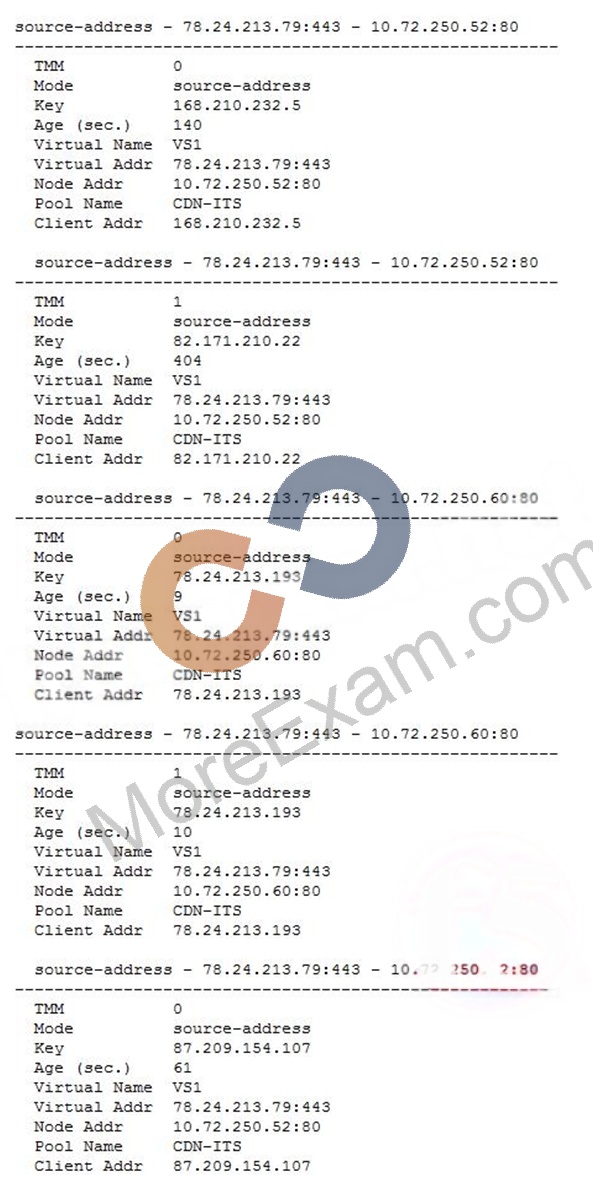
-- Exhibit --
Refer to the exhibit.
A virtual server is set up on an LTM device as follows:
Virtual server address 78.24.213.79
Default Persistence ProfilE. source_addr, 600s.
Pool NamE. Pool1
Pool Members: 10.72.250.52:80 and 10.72.250.60:80 (both on Internal Vlan) There are several current connections to the virtual server, and pool member 10.72.250.52:80 has been set to a "Disabled" state.
A tcpdump on the Internal Vlan shows traffic going to 10.72.250.52:80.
How soon after the persistence table query was run can existing connections be refreshed/renewed to ensure that no requests are sent to 10.72.250.52?
Question6: -- Exhibit -


-- Exhibit --
Refer to the exhibits.
A customer requests to offload SSL for an internal website. The front page of the website loads correctly; however, selecting links on the page fails.
How should the LTM Specialist fix the issue?
Question7: Which two subsystems could the LTM Specialist utilize to access an LTM device with lost management interface connectivity? (Choose two.)
Question8: An LTM Specialist configured a virtual server to load balance a custom application. The application works when it is tested from within the firewall but it fails when tested externally. The pool member address is
192.168.200.10:80. A capture from an external client shows:
GET /index.jsp HTTP/1.1
Host: 207.206.201.100
User-Agent: Mozilla/5.0 (Windows NT 6.1; WOW64; rv:15.0) Gecko/20100101 Firefox/15.0.1 Accept: text/html,application/xhtml+xml,application/xml;q=0.9,*/*;q=0.8 Connection: keep-alive HTTP/1.1 302 Found DatE. Wed, 17 Oct 2012 23:09:55 GMT Server: Apache/2.2.15 (CentOS) Location: http://192.168.200.10/user/home.jsp Content-LengtH. 304 Connection: close What is the solution to this issue?
Question9: -- Exhibit -

-- Exhibit --
Refer to the exhibit.
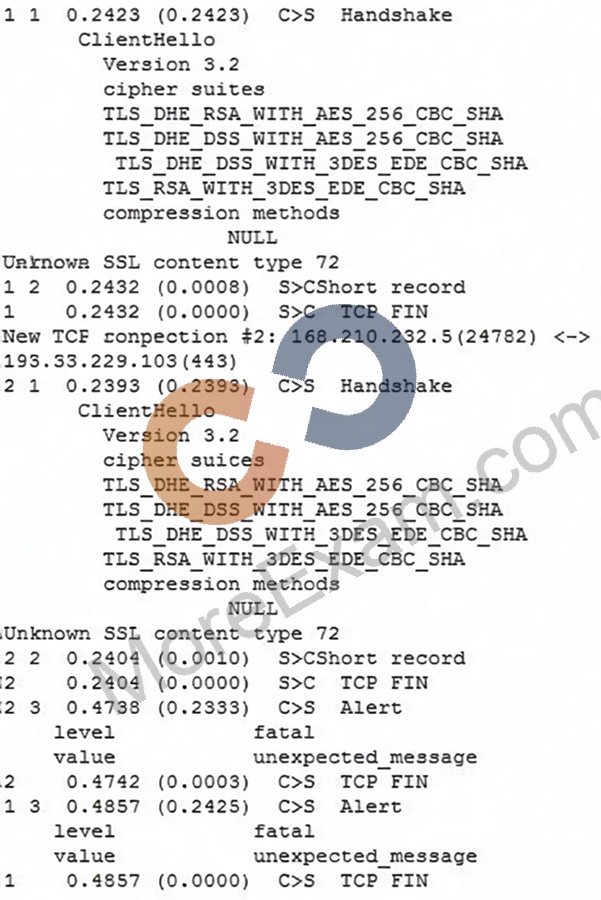
A client attempts to connect from a Google Chrome browser to a virtual server on a BIG-IP LTM.
The virtual server is SSL Offloaded. When the client connects, the client receives an SSL error.
After trying Mozilla Firefox and Internet Explorer browsers, the client still receives the same errors.
The LTM Specialist does an ssldump on the virtual server and receives the results as per the exhibit.
What is the problem?
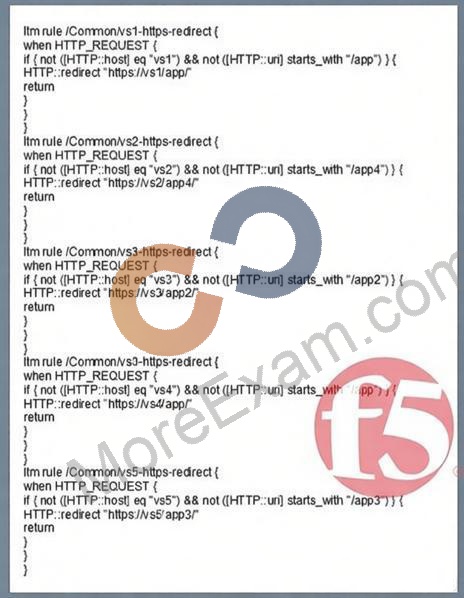
Question10: -- Exhibit - -- Exhibit -

Refer to the exhibits.
An LTM Specialist configures a virtual server for an internal application to perform client-side encryption while allowing the server-side traffic to be unencrypted. Application users report that images are NOT loading through the virtual server; however, images load when going directly to the server.
What should the LTM Specialist configure to allow the images to load through the virtual server?
Question11: While investigating the cause of a device failover, an LTM Specialist discovers the following events in /var/log/ltm:
01010029:5: Clock advanced by 518 ticks 01010029:5: Clock advanced by 505 ticks 01010029:5: Clock advanced by 590 ticks 01010029:5: Clock advanced by 568 ticks 01010029:5: Clock advanced by 1681 ticks 01010029:5: Clock advanced by 6584 ticks 01140029:5: HA daemon_heartbeat tmm fails action is failover and restart. 010c0026:5: Failover condition, active attempting to go standby.
Which issue caused the failover?
Question12: Which command should the LTM Specialist use to determine the current system time?
Question13: -- Exhibit -
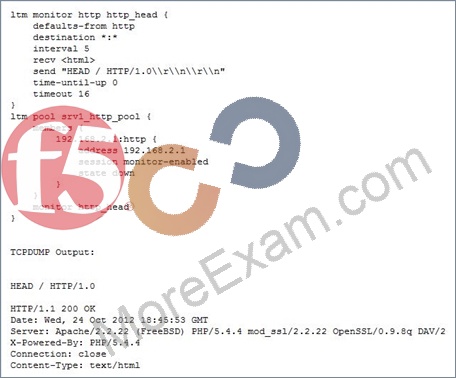
-- Exhibit --
Refer to the exhibit.
An LTM Specialist is troubleshooting a new HTTP monitor on a pool. The pool member is functioning correctly when accessed directly through a browser. However, the monitor is marking the member as down. The LTM Specialist captures the monitor traffic via tcpdump.
What is the issue?
Question14: -- Exhibit -
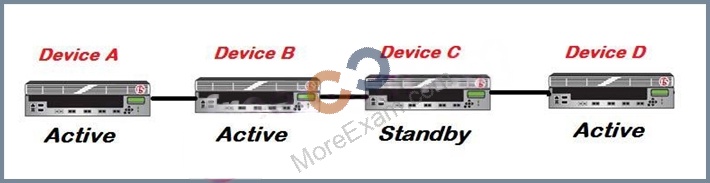
-- Exhibit --
Refer to the exhibit.
An LTM Specialist is upgrading the LTM devices.
Which device should be upgraded first?
Question15: What is a benefit provided by F5 Enterprise Manager?
Question16: -- Exhibit -
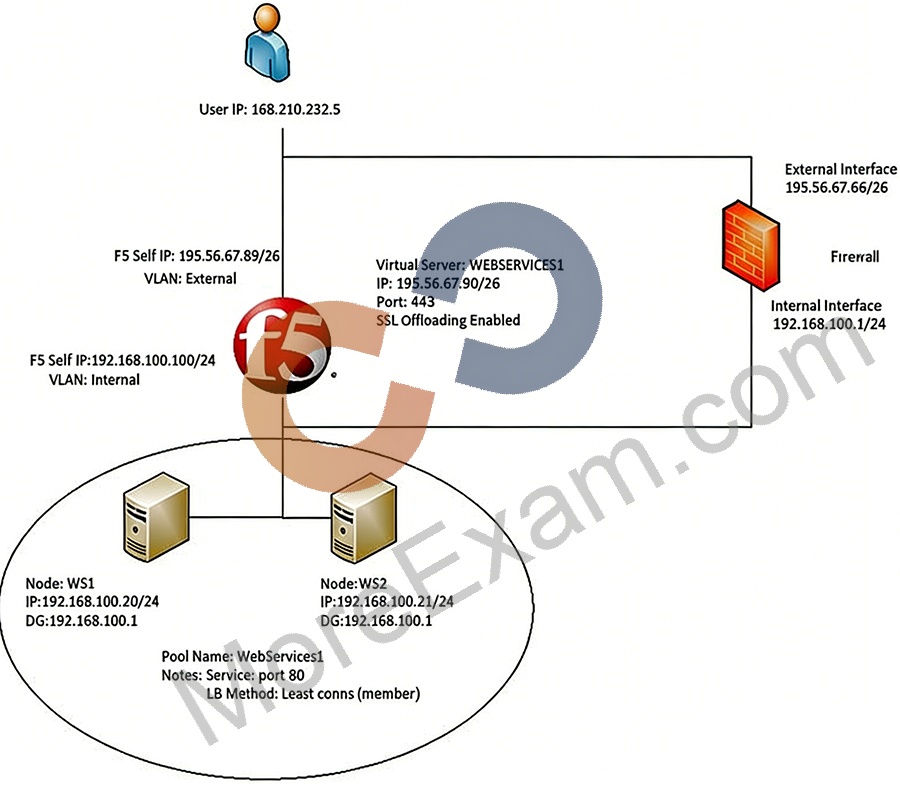
-- Exhibit --
Refer to the exhibit.
Users receive an error when attempting to connect to the website https://website.com. The website has a DNS record of 195.56.67.90. The upstream ISP has confirmed that there is nothing wrong with the routing between the user and the LTM device.
The following tcpdump outputs have been captured:
External Vlan, filtered on IP 168.210.232.5
00:25:07.598519 IP 168.210.232.5.33159 > 195.56.67.90.https: S 1920647964:1920647964(0) win 8192
<mss 1450,nop,nop,sackOK>
00:25:07.598537 IP 195.56.67.90.https > 168.210.232.5.33159: S 2690691360:2690691360(0) ack
1920647965 win 4350 <mss 1460,sackOK,eol>
00:25:07.598851 IP 168.210.232.5.33160 > 195.56.67.90.https: S 2763858764:2763858764(0) win 8192
<mss 1450,nop,nop,sackOK>
00:25:07.598858 IP 195.56.67.90.https > 168.210.232.5.33160: S 1905576176:1905576176(0) ack
2763858765 win 4350 <mss 1460,sackOK,eol>
Internal Vlan, filtered on IP 168.210.232.5
00:31:46.171124 IP 168.210.232.5.33202 > 192.168.100.20.http: S 2389057240:2389057240(0) win 4380
<mss 1460,nop,wscale 0,sackOK,eol>
What is the problem?
Question17: An application is configured on an LTM device:
Virtual server: 10.0.0.1:80 (VLAN vlan301)
SNAT IP: 10.0.0.1
Pool members: 10.0.1.1:8080, 10.0.1.2:8080, 10.0.1.3:8080 (VLAN vlan302) Which packet capture should the LTM Specialist perform on the LTM device command line interface to capture only server traffic specifically for this application?
Question18: An HTTP 1.1 application utilizes chunking.
Which header should be used to notify the client's browser that there are additional HTTP headers at the end of the message?
Question19: An LTM Specialist sees these entries in /var/log/ltm:
Oct 25 03:34:31 tmm warning tmm[7150]: 01260017:4: Connection attempt to insecure SSL server (see RFC5746) aborteD.172.16.20.1:443
Oct 25 03:34:32 tmm warning tmm[7150]: 01260017:4: Connection attempt to insecure SSL server (see RFC5746) aborteD.172.16.20.1:443
Oct 25 03:34:32 tmm warning tmm[7150]: 01260017:4: Connection attempt to insecure SSL server (see RFC5746) aborteD.172.16.20.1:443
Oct 25 03:34:32 tmm warning tmm[7150]: 01260017:4: Connection attempt to insecure SSL server (see RFC5746) aborteD.172.16.20.1:443
Oct 25 03:34:32 tmm warning tmm[7150]: 01260017:4: Connection attempt to insecure SSL server (see RFC5746) aborteD.172.16.20.1:443
Oct 25 03:34:33 tmm warning tmm[7150]: 01260017:4: Connection attempt to insecure SSL server (see RFC5746) aborteD.172.16.20.1:443
Assume 172.16.20.0/24 is attached to the VLAN "internal."
What should the LTM Specialist use to troubleshoot this issue?
Question20: An LTM device is deployed in a one-armed topology. The virtual server, clients, and web servers are connected on the LTM device internal VLAN. A client tries to connect to the virtual server and is unable to establish a connection. A packet capture from the LTM device internal VLAN shows that the HTTP request is being forwarded to the web server.
From which two additional locations should protocol analyzer data be collected? (Choose two.)
Question21: -- Exhibit -

-- Exhibit --
Refer to the exhibit.
A client attempts to connect from a Google Chrome browser to a virtual server on a BIG-IP LTM. The virtual server is SSL Offloaded. When the client connects, the client receives an SSL error. After trying Mozilla Firefox and Internet Explorer browsers, the client still receives the same errors.
The LTM Specialist does an ssldump on the virtual server and receives the results as per the exhibit.
What is the problem?
Question22: -- Exhibit -


-- Exhibit --
Refer to the exhibits.
Every monitor has the same Send String, Recv String, and an Alias of *:*. The LTM Specialist simplifies the configuration to minimize the number of monitors.
How many unique monitors remain?
Question23: An LTM device is monitoring pool members on port 80. The LTM device is using an HTTP monitor with a send string of GET / and a blank receive string.
What would cause the pool members to be marked down?
Question24: -- Exhibit -

-- Exhibit -Refer to the exhibit.
An administrator created a monitor to a pool member web server, which resulted in a pool member that is marked red. The administrator knows the web server is working when it is accessed from another computer.
What should the administrator do to correct the problem?
Question25: The output of a tmsh command is: ------------------------------------------------------------ Net::Interface Name Status Bits Bits Errs Errs Drops Drops Colli In Out In Out In Out sions ----------------------------------------------------------- 1.1 down 0 0 0 0 0 0 0 1.2 up 191.4K 0 0 0 374 0 0 1.3 down 0 0 0 0 0
0 0 1.4 up 22.5K 0 0 0 44 0 0 2.1 miss 0 0 0 0 0 0 0 2.2 miss 0 0 0 0 0 0 0 mgmt up 43.2G 160.0G 0 0 0 0 0
Which command was executed on the LTM device to show the output?
Question26: -- Exhibit -


-- Exhibit --
Refer to the exhibits.
Users are able to access the application when connecting directly to the web server but are unsuccessful when connecting to the virtual server. Return traffic bypasses the LTM device using Layer 2 nPath routing.
Which configuration change resolves this problem?
Question27: An LTM Specialist needs to rewrite text within an HTML response from a web server. A client is sending the following HTTP request:
GET / HTTP/1.1
Host: www.example.com
User-Agent: Mozilla/5.0 (Windows NT 6.1; WOW64; rv:16.0) Gecko/20100101 Firefox/16.0 Accept: text/html,application/xhtml+xml,application/xml;q=0.9,*/*;q=0.8 Accept-LanguagE. en-US,en;q=0.5 Accept-EncodinG. gzip, deflate Cache-Control: no-cache Connection: keep-alive CookiE. somecookie=1 HTTP/1.1 200 OK Server: Apache/2.2.15 (Unix) Last-ModifieD. Wed, 12 Aug 2009 00:00:30 GMT Accept-Ranges: bytes Content-LengtH. 1063 X-Cnection: close Content-TypE. text/html; charset=UTF-8 Vary: Accept-Encoding Content-EncodinG. gzip Connection: Keep-Alive Although a stream profile has been added to the virtual server, the content within the HTTP response is NOT being matched and therefore NOT modified.
Which header field is contributing to the issue?
Question28: A device on the network is configured with the same IP address as the management address of the active LTM device, causing the management GUI to be inaccessible.
Which two methods should the LTM Specialist use to access the LTM device in order to change the management IP address? (Choose two.)
Question29: -- Exhibit -

-- Exhibit -
Refer to the exhibit.
An LTM Specialist has a virtual server set up on the LTM device as per the exhibit. The LTM Specialist receives reports of intermittent issues. Some clients are connecting fine while others are failing to connect.
The LTM Specialist does a tcpdump on the relevant interfaces, with the following results extracted:
What is causing the intermittent issues?
Question30: The LTM Specialist is writing a custom HTTP monitor for a web application and has viewed the content by accessing the site directly via their browser. The monitor continually fails. The monitor configuration is:
ltm monitor http /Common/exampleComMonitor {
defaults-from /Common/http
destination *:*
interval 5
recv "Recent Searches"
send "GET /app/feed/current\?uid=20145 HTTP/1.1\\r\\nHost: www.example.com\\r\\nAccept-EncodinG.
gzip, deflate\\r\\nConnection: close\\r\\n\\r\\n"
time-until-up 0
timeout 16
}
A trace shows the following request and response:
Request:
GET /app/feed/current?uid=20145 HTTP/1.1
Host www.example.com
Accept-Encoding gzip, deflate
Connection: close
Response:
HTTP/1.1 302 Moved Temporarily
Date Wed, 17 Oct 2012 18:45:52 GMT
Server Apache
Location https://example.com/login.jsp
Content-Encoding gzip
Content-Type text/html;charset=UTF-8
Set-CookiE. JSESSIONID=261EFFBDA8EC3036FBCC22D991AC6835; Path=/app/feed/current?uid=20145 What is the problem?
Question31: -- Exhibit -

-- Exhibit -Refer to the exhibit. A pair of LTM devices are configured for HA. The LTM Specialist observes from a capture that
there is a successful connection from a client directly to a web server and an unsuccessful
connection from a client via the LTM device to the same web server.
Which two solutions will solve the configuration problem? (Choose two.)
Question32: There is a fault with an LTM device load balanced trading application that resides on directly connected VLAN vlan-301. The application virtual server is 10.0.0.1:80 with trading application backend servers on subnet 192.168.0.0/25. The LTM Specialist wants to save a packet capture with complete payload for external analysis.
Which command should the LTM Specialist execute on the LTM device command line interface?
Question33: -- Exhibit --- Exhibit -Refer to the exhibit.

A company uses a complex piece of client software that connects to one or more virtual servers (VS) hosted on an LTM device. The client software is experiencing issues. An LTM Specialist must determine the cause of the problem. The LTM Specialist has the tcpdump extract. The client loses connection with the LTM device.
Where is the reset originating?
Question34: Given LTM device ltm log:
Sep 26 20:51:08 local/lb-d-1 notice promptstatusd[3695]: 01460006:5: semaphore mcpd.running(1) held Sep 26 20:51:08 local/lb-d-1 notice promptstatusd[3695]: 01460006:5:
Sep 26 20:51:08 local/lb-d-1 warning promptstatusd[3695]: 01460005:4: mcpd.running(1) held, wait for mcpd Sep 26 20:51:08 local/lb-d-1 info sod[3925]: 010c0009:6: Lost connection to mcpd - reestablishing.
Sep 26 20:51:08 local/lb-d-1 err bcm56xxd[3847]: 012c0004:3: Lost connection with MCP: 16908291 ... Exiting bsx_connect.cpp(174) Sep 26 20:51:08 local/lb-d-1 info bcm56xxd[3847]: 012c0012:6: MCP Exit Status Sep 26 20:51:08 local/lb-d-1 info bcm56xxd[3847]: 012c0012:6: Info: LACP stats (time now:1348717868) : no traffic Sep 26 20:51:08 local/lb-d-1 info bcm56xxd[3847]: 012c0014:6: Exiting...
Sep 26 20:51:08 local/lb-d-1 err lind[3842]: 013c0004:3: IO error on recv from mcpd - connection lost Sep 26 20:51:08 local/lb-d-1 notice bigd[3837]: 01060110:5: Lost connection to mcpd with error 16908291, will reinit connection.
Sep 26 20:51:08 local/lb-d-1 err statsd[3857]: 011b0004:3: Initial subscription for system configuration failed with error '' Sep 26 20:51:08 local/lb-d-1 err statsd[3857]: 011b0001:3: Connection to mcpd failed with error '011b0004:3:
Initial subscription for system configuration failed with error '''
Sep 26 20:51:08 local/lb-d-1 err csyncd[3851]: 013b0004:3: IO error on recv from mcpd - connection lost
.............skipping more logs.....
Sep 26 20:51:30 local/lb-d-1 notice sod[3925]: 01140030:5: HA proc_running bcm56xxd is now responding.
Sep 26 20:51:34 local/lb-d-1 notice sod[3925]: 01140030:5: HA proc_running mcpd is now responding.
Sep 26 20:51:34 local/lb-d-1 notice sod[3925]: 010c0018:5: Standby
Which daemon failed?
Question35: -- Exhibit- -- Exhibit -

Refer to the exhibit.
Which URL should be reported to the server/application team as getting user-visible errors?
Question36: -- Exhibit-

-- Exhibit -
Refer to the exhibit.
A pair of LTM devices are deployed in a high-availability (HA) pair as the diagram shows. After inserting a new rule on the firewalls, the LTM devices become Standby. The rule drops alloutbound sessions to the Internet. Only inbound connections are allowed from the Internet. There are no other changes to the environment.
What triggered the LTM device failover?
Question37: An LTM Specialist wants to allow access to the Always On Management (AOM) from the network.
Which two methods should the LTM Specialist use to configure the AOM interface? (Choose two.)
Question38: Given this as the first packet displayed of an ssldump:
2 2 1296947622.6313 (0.0001) S>CV3.1(74) Handshake ServerHello Version 3.1 random[32]= 19 21 d7 55 c1 14 65 63 54 23 62 b7 c4 30 a2 f0 b8 c4 20 06 86 ed 9c 1f 9e 46 0f 42 79 45 8a 29 session_id[32]= c4 44 ea 86 e2 ba f5 40 4b 44 b4 c2 3a d8 b4 ad
4c dc 13 0d 6c 48 f2 70 19 c3 05 f4 06 e5 ab a9
cipherSuite TLS_RSA_WITH_RC4_128_SHA
compressionMethod NULL
In reviewing the rest of the ssldump, the application data is NOT being decrypted.
Why is ssldump failing to decrypt the application data?
Question39: -- Exhibit -

-- Exhibit --
Refer to the exhibit.
A user is unable to access an application.
What is the root cause of the problem?
Question40: -- Exhibit -

-- Exhibit --
Refer to the exhibit.
A server administrator notices that one server is intermittently NOT being sent any HTTP requests. The server logs display no issues. The LTM Specialist notices log entries stating the node (172.16.20.1) status cycling between down and up. The pool associated with the virtual server (10.10.1.100) has a custom HTTP monitor applied.
Which tcpdump filter will help trace the monitor?
Question41: An LTM Specialist is investigating reports from users that SSH connections are being terminated unexpectedly.
SSH connections are load balanced through a virtual server. The users experiencing this problem are running SQL queries that take upwards of 15 minutes to return with no screen output. The virtual server is standard with a pool associated and no other customizations.
What is causing the SSH connections to terminate?
Question42: A stand-alone LTM device is to be paired with a second LTM device to create an active/standby pair. The current stand-alone LTM device is in production and has several VLANs with floating IP addresses configured. The appropriate device service clustering (DSC) configurations are in place on both LTM devices.
Which two non-specific DSC settings should the LTM Specialist configure on the second LTM device to ensure no errors are reported when attempting to synchronize for the first time? (Choose two.)
Question43: -- Exhibit- -- Exhibit -

Refer to the exhibit.
An LTM Specialist is troubleshooting an issue with SSL and is receiving the error shown when connecting to the virtual server. When connecting directly to the pool member, clients do NOT receive this message, and the application functions correctly. The LTM Specialist exports theappropriate certificate and key from the pool member and imports them into the LTM device. The LTM Specialist then creates the Client SSL profile and associates it with the virtual server.
What is the issue?
Question44: -- Exhibit -

-- Exhibit -Refer to the exhibit.
An LTM Specialist is troubleshooting an issue with a new virtual server. When connecting through the virtual server, clients receive the message "The connection was reset" in the browser. Connections directly to the pool member show the application is functioning correctly.
What is the issue?
Question45: An LTM Specialist with the Administrator role and terminal access of "tmsh" logs in via ssh and is in the Traffic Manager Shell. The LTM Specialist wants to enter the bash shell to review log files.
Which command does the LTM Specialist need to run to access the bash shell?
Question46: A new web application is hosted at www.example.net, but some clients are still pointing to the legacy web application at www.example.com.
Which iRule will allow clients referencing www.example.com to access the new application?
Question47: -- Exhibit -


-- Exhibit --
Refer to the exhibits.
An LTM device has been configured for load balancing a number of different application servers.
Configuration changes need to be made to the LTM device to allow administrative management of the servers in 172.16.10/24, 172.16.20/24, and 172.16.30/24 networks. The servers require outbound access to numerous destinations for operations.
Which solution has the simplest configuration changes while maintaining functionality and basic security?
Question48: -- Exhibit-

-- Exhibit --
Refer to the exhibit.
Which pool can be removed without affecting client traffic?
Question49: An LTM Specialist notices the following error on the stdout console:
mcpd[2395]: 01070608:0: License is not operational(expired or digital signature does not match contents)
Which command should be executed to verify the LTM device license?
Question50: An LTM Specialist must perform a packet capture on a virtual server with an applied standard FastL4 profile.
The virtual server 10.0.0.1:443 resides on vlan301.
Which steps should the LTM Specialist take to capture the data payload successfully while ensuring no other virtual servers are affected?
Question51: -- Exhibit -
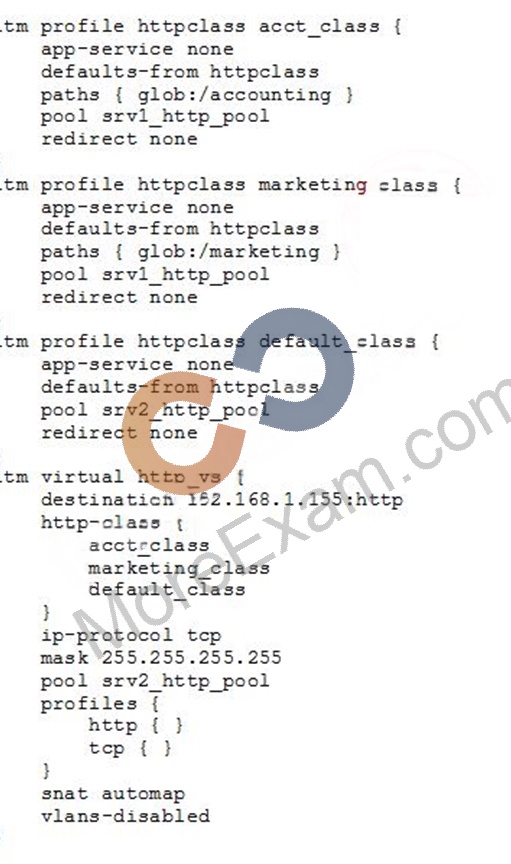
-- Exhibit --
Refer to the exhibit.
An LTM Specialist is reviewing the virtual server configuration on an LTM device.
Which two actions should the LTM Specialist perform to minimize the virtual server configuration? (Choose two.)
Question52: An LTM Specialist notices the following error on the stdout console:
mcpd[2395]: 01070608:0: License is not operational(expired or digital signature does not match contents) Which command should be executed to verify the LTM device license?
Question53: -- Exhibit -

-- Exhibit --
Refer to the exhibit.
A virtual server is set up on an LTM device as follows:
Virtual server address 78.24.213.79
Default Persistence ProfilE. source_addr, 600s.
Pool NamE. Pool1
Pool Members: 10.72.250.52:80 and 10.72.250.60:80 (both on Internal Vlan) There are several current connections to the virtual server, and pool member 10.72.250.52:80 has been set to a "Disabled" state.
A tcpdump on the Internal Vlan shows traffic going to 10.72.250.52:80.
How soon after the persistence table query was run can existing connections be refreshed/renewed to ensure that no requests are sent to 10.72.250.52?
Question54: Which command will identify the active LTM device currently handling client traffic?
Question55: An LTM device has a virtual server configured as a Performance Layer 4 virtual listening on
0.0.0.0:0 to perform routing of packets to an upstream router. The client machine at IP address
192.168.0.4 is attempting to contact a host upstream of the LTM device on IP address 10.0.0.99.
The network flow is asymmetrical, and the following TCP capture displays:
# tcpdump -nnni 0.0 'host 192.168.0.4 and host 10.0.0.99' tcpdump: verbose output suppressed, use -v or -vv for full protocol decode listening on 0.0, link-type EN10MB (Ethernet), capture size 96 bytes
05:07:55.499954 IP 192.168.0.4.35345 > 10.0.0.99.443: S 3205656213:3205656213(0) ack
3267995082 win 1480 05:07:55.499983 IP 10.0.0.99.443 > 192.168.0.4.35345: R 1:1(0) ack 1 win 0 05:07:56.499960 IP 192.168.0.4.35345 > 10.0.0.99.443: S 3205656213:3205656213(0) ack
3267995082 win 1480 05:07:56.499990 IP 10.0.0.99.443 > 192.168.0.4.35345: R 1:1(0) ack 1 win 0 4 packets captured
Which option within the fastL4 profile needs to be enabled by the LTM Specialist to prevent the LTM device from rejecting the flow?
Question56: Users are experiencing low throughput when downloading large files over a high-speed WAN connection. Extensive packet loss was found to be an issue but CANNOT be eliminated.
Which two TCP profile settings should be modified to compensate for the packet loss in the network? (Choose two.)
Question57: An LTM Specialist defines a receive string in the HTTP monitor and then assigns it to the HTTP pool. The monitor has an interval of 5 seconds and a timeout of 16 seconds.
If the receive string is NOT seen in the the HTTP payload after 20 seconds, how does the LTM device mark the monitor status?
Question58: A failover event is recorded in the following log messages:
Jan 01 00:56:56 BIG-IP notice mcpd[5318]: 01070727:5: Pool /Common/my-pool member /Common/10.0.0.10:80 monitor status down.
Jan 01 00:56:56 BIG-IP notice sod[5855]: 010c0045:5: Leaving active, group score 10 peer group score 20.
Jan 01 00:56:56 BIG-IP notice sod[5855]: 010c0052:5: Standby for traffic group /Common/traffic-group-1.
Jan 01 00:56:56 BIG-IP notice sod[5855]: 010c0018:5: Standby
Jan 01 00:57:06 BIG-IP notice logger: /usr/bin/tmipsecd --tmmcount 4 ==> /usr/bin/bigstart stop racoon
What is the cause of the failover?
Question59: -- Exhibit- -- Exhibit -Refer to the exhibit.

An LTM device is used to load balance web content over a secure channel.
The developers of the web content have done a trace using an HTTP profiler application.
They believe that allowing the LTM device to compress traffic to the client will improve
performance. The client can utilize GZIP or deflate compression algorithms.
An LTM Specialist must implement the compression.
The LTM Specialist has completed the following actions:
1.Create the relevant profile.
2.Apply the relevant profile to the virtual server (VS).
After applying the relevant profile, the LTM device is failing to compress the traffic. Instead,
the traffic is being served with an error.
What is the problem?
Question60: These log entries can have different root causes:
Jun 28 05:01:21 LTM_A notice mcpd[27545]: 0107143a:5: CMI reconnect timer: enabled Jun 28 05:01:21 LTM_A notice mcpd[27545]: 01071431:5: Attempting to connect to CMI peer 1.1.1.2 port
6699
Jun 28 05:01:21 LTM_A notice mcpd[27545]: 01071432:5: CMI peer connection established to 1.1.1.2 port
6699
Jun 28 05:01:26 LTM_A notice mcpd[27545]: 0107143a:5: CMI reconnect timer: disabled, all peers are connected Which two commands should be used to obtain additional information on these entries? (Choose two.)
Question61: An LTM device is load balancing SIP traffic. An LTM Specialist notices that sometimes the SIP request is being load balanced to the same server as the initial connection.
Which setting in the UDP profile will make the LTM device more evenly distribute the SIP traffic?
Question62: A web developer has created a custom HTTP call to a backend application. The HTTP headers being sent by the HTTP call are:
GET / HTTP/1.1
User-Agent: MyCustomApp (v1.0)
Accept: text/html
Cache-Control: no-cache
Connection: keep-alive
CookiE. somecookie=1
The backend server is responding with the following:
HTTP/1.1 400 Bad Request
DatE. Wed, 20 Jul 2012 17:22:41 GMT
Connection: close
Why is the HTTP web server responding with a HTTP 400 Bad Request?
Question63: -- Exhibit -

-- Exhibit --
Refer to the exhibit.
An LTM Specialist is troubleshooting an issue with SSL and is receiving the error shown when connecting to the virtual server. When connecting directly to the pool member, clients do NOT receive this message, and the application functions correctly. The LTM Specialist exports the appropriate certificate and key from the pool member and imports them into the LTM device. The LTM Specialist then creates the Client SSL profile and associates it with the virtual server.
What is the issue?
Question64: The following decoded TCPDump capture shows the trace of a failing health monitor.
00:00:13.245104 IP 10.29.29.60.51947 > 10.0.0.12.http: P 1:59(58) ack 1 win 46
<nop,nop,timestamp 2494782300 238063789> out slot1/tmm3 lis=
0x0000: 4500 006e 3b19 4000 4006 ce0c 0a1d 1d3c E..n;.@.@......<
0x0010: 0a00 000c caeb 0050 8be5 aca3 dd65 e3e1 .......P.....e..
0x0020: 8018 002e 1b41 0000 0101 080a 94b3 5b5c .....A........[\
0x0030: 0e30 90ad 4745 5420 2f74 6573 745f 7061 .0..GET./test_pa
0x0040: 6765 2e68 746d 6c20 4854 5450 312e 310d ge.html.HTTP1.1.
0x0050: 0a48 6f73 743a 200d 0a43 6f6e 6e65 6374 .Host:...Connect
0x0060: 696f 6e3a 2043 6c6f 7365 0d0a 0d0a 0105 ion:.Close......
0x0070: 0100 0003 00 .....
00:00:13.245284 IP 10.0.0.12.http > 10.29.29.60.51947: . ack 59 win 362
<nop,nop,timestamp 238063789 2494782300> in slot1/tmm3 lis=
0x0000 0ffd 0800 4500 00c9 6f68 4000 8006 755d [email protected]]
0x0010 0a29 0015 0a29 0103 0050 e0d6 4929 90eb .)...)...P..I)..
0x0020 6f12 d83c 8019 fab3 9b31 0000 0101 080a o..<.....1......
0x0030 0068 4e10 5240 6150 4854 5450 2f31 2e31 .hN.R@aPHTTP/1.1
0x0040 2034 3030 2042 6164 2052 6571 7565 7374 .400.Bad.Request
0x0050 0d0a 436f 6e74 656e 742d 5479 7065 3a20 ..Content-Type:.
0x0060 7465 7874 2f68 746d 6c0d 0a44 6174 653a text/html..Date:
0x0070 2054 6875 2c20 3231 204a 616e 2032 3031 .Mon,.01.Jan.201
0x0080 3020 3138 3a35 383a 3537 2047 4d54 0d0a 2.00:00:01.GMT..
0x0090 436f 6e6e 6563 7469 6f6e 3a20 636c 6f73 Connection:.clos
0x00a0 650d 0a43 6f6e 7465 6e74 2d4c 656e 6774 e..Content-Lengt
0x00b0 683a 2032 300d 0a0d 0a3c 6831 3e42 6164 h:.20....<h1>Bad
0x00c0 2052 6571 7565 7374 3c2f 6831 3e .Request</h1>
The health monitor is sending the string shown in the capture; however, the server response is NOT as expected. The correct response should be an HTML page including the string 'SERVER IS UP'.
What is the issue?
Question65: -- Exhibit -


-- Exhibit -
Refer to the exhibits.
An LTM device has been configured for load balancing a number of different application servers. Configuration changes need to be made to the LTM device to allow administrative management of the servers in 172.16.10/24, 172.16.20/24, and 172.16.30/24 networks. The servers require outbound access to numerous destinations for operations.
Which solution has the simplest configuration changes while maintaining functionality and basic security?
Question66: -- Exhibit -

-- Exhibit -
Refer to the exhibit.
An LTM Specialist is investigating reports that users are unable to perform some commands through an FTP virtual server. The LTM Specialist performs a capture on the server side of the LTM device.
What is the issue with the application?
Question67: -- Exhibit -

-- Exhibit -Refer to the exhibits.
Every monitor has the same Send String, Recv String, and an Alias of *:*. The LTM Specialist simplifies the configuration to minimize the number of monitors.
How many unique monitors remain?
Question68: An LTM Specialist needs to rewrite text within an HTML response from a web server. A client is sending the HTTP request below:
GET / HTTP/1.1
Host: www.f5.com
User-Agent: Mozilla/5.0 (Windows NT 6.1; WOW64; rv:16.0) Gecko/20100101 Firefox/16.0 Accept: text/html,application/xhtml+xml,application/xml;q=0.9,*/*;q=0.8 Accept-LanguagE. en-US,en;q=0.5
Accept-EncodinG. gzip, deflate
Cache-Control: no-cache
Connection: keep-alive
CookiE. somecookie=1
Although a stream profile has been added to the virtual server, the content within the HTTP response is NOT being matched, and therefore NOT modified.
Which HTTP header should the LTM Specialist remove from the request to ensure the content can be matched and modified?
Question69: An LTM Specialist configures the following iRule on an LTM device:
when HTTP_REQUEST { if {[string tolower [HTTP::uri]] contains "/URI1/" } { pool Pool1 } elseif {[string tolower [HTTP::uri]] contains "/URI2/" } { pool Pool2 } elseif {[string tolower [HTTP::uri]] contains "/URI3/" } { pool Pool3 } else { pool Pool4} }
Given the following request: http://www.example.comURI1/index.html?fu=bar&pass=1234
Which pool will be selected by the iRule?
Question70: An LTM Specialist connects to an LTM device via the serial console cable and receives unreadable output. The LTM Specialist is using the appropriate cable and connecting it to the correct serial port.
Which command should the LTM Specialist run through ssh to verify that the baud rate settings for the serial port are correct on the LTM device?
Question71: The output of a tmsh command is: ------------------------------------------------------------ Net::Interface Name Status Bits Bits Errs Errs Drops Drops Colli In Out In Out In Out sions
------------------------------------------------------------ 1.1 down 0 0 0 0 0 0 0 1.2 up 191.4K 0 0 0 374 0 0 1.3 down 0 0
0 0 0 0 0 1.4 up 22.5K 0 0 0 44 0 0 2.1 miss 0 0 0 0 0 0 0 2.2 miss 0 0 0 0 0 0 0 mgmt up 43.2G 160.0G 0 0 0 0
0
Which command was executed on the LTM device to show the output?
Question72: -- Exhibit-

-- Exhibit -Refer to the exhibit. An LTM Specialist is working on an LTM 11.0.0 installation and has identified a security
vulnerability as shown in the exhibit. The LTM Specialist is tasked with applying the latest
available hotfix to resolve the problem.
Which procedure resolves the problem?
Question73: What is the correct command to reset an LTM device to its default settings?
Question74: Users in a branch office are reporting a website is always slow. No other users are experiencing the problem.
The LTM Specialist tests the website from the external VLAN along with testing the servers directly. All tests indicate normal behavior. The environment is a single HTTP virtual server on the external VLAN with a single pool containing three HTTP pool members on the internal VLAN.
Which two locations are most appropriate to collect additional protocol analyzer data? (Choose two.)
Question75: There is a fault with an LTM device load balanced trading application that resides on directly connected VLAN vlan-301. The application virtual server is 10.0.0.1:80 with trading application backend servers on subnet 192.168.0.0/25. The LTM Specialist wants to save a packet capture with complete payload for external analysis.
Which command should the LTM Specialist execute on the LTM device command line interface?
Question76: An LTM Specialist is receiving reports from customers about multiple applications failing to work properly.
The LTM Specialist looks at the services running and notices that the bigd process has NOT started.
How are monitored LTM device objects marked when the bigd process is stopped?
Question77: A customer needs to intercept all of the redirects its application is sending to clients. When a redirect is matched, the customer needs to log a message including the client IP address.
Which iRule should be used?
Question78: An LTM HTTP pool has an associated monitor that sends a string equal to 'GET /test.html'.
Which two configurations could an LTM Specialist implement to allow server administrators to disable their pool member servers without logging into the LTM device? (Choose two.)
Question79: An LTM Specialist is troubleshooting an issue where one LTM device in a three LTM device group is failing to synchronize after a synchronize to group command is issued. The LTM Specialist verifies there are no packet filters, port lock down, or network issues preventing the connection.
What are two reasons the synchronization group is having issues? (Choose two.)
Question80: -- Exhibit- -- Exhibit -


Refer to the exhibits.
An LTM Specialist has configured a virtual server to distribute connections to a pool of application servers and to offload SSL processing. The application fails to work as expected when connecting to the virtual server. It does work when clients connect directly to the application. Two packet captures were taken at the application server.
What is the root cause of the problem?
Question81: -- Exhibit -

-- Exhibit --
Refer to the exhibit.
The decoded TCPDump capture is a trace of a failing health monitor. The health monitor is sending the string shown in the capture; however, the server response is NOT as expected. The receive string is set to
'SERVER IS UP'.
What is the solution?
Question82: Which command should an LTM Specialist use on the command line interface to show the health of RAID array hard drives?
Question83: An HA pair of LTM devices configured in Active-Standby mode stops responding to traffic and causes an outage. The Active device becomes Standby, but the partner device stays in Standby mode instead of taking over as Active. A reboot and restart of the services brings the LTM device to Active mode for a short time, but then it goes into Standby mode again.
Which two configuration components caused this condition? (Choose two.)
Question84: Which two items can be logged by the Application Visibility Reporting analytics profile? (Choose two.)
Question85: Given:
Filesystem Size Used Avail Use% Mounted on /dev/md11 248M 248M 0 100% / /dev/md13 3.0G 76M 2.8G 3% /config /dev/md12 1.7G 1.1G 476M 71% /usr /dev/md14 3.0G 214M 2.6G 8% /var /dev/md0 30G 2.2G 26G 8% /shared /dev/md1 6.9G 288M 6.3G 5% /var/log none 3.9G 452K 3.9G 1% /dev/shm none 3.9G 19M 3.9G 1% /var/tmstat none 3.9G 1.2M 3.9G 1% /var/run prompt 4.0M 12K 4.0M 1% /var/prompt /dev/md15 12G 8.3G 3.1G 74% /var/lib/mysql
Which command is used to produce this output?
Question86: An LTM Specialist realizes that a datacenter engineer has changed the console baud rate.
Which command determines the current baud rate via the command line interface?
Question87: An LTM device pool has suddenly been marked down by a monitor. The pool consists of members 10.0.1.1:443 and 10.0.1.2:443 and are verified to be listening. The affected virtual server is 10.0.0.1:80.
Which two tools should the LTM Specialist use to troubleshoot the associated HTTPS pool monitor via the command line interface? (Choose two.)
Question88: -- Exhibit-
-- Exhibit -Refer to the exhibit.
An administrator created a monitor to a pool member web server, which resulted in a pool member that is marked red. The administrator knows the web server is working when it is accessed from another computer.
What should the administrator do to correct the problem?
Question89: -- Exhibit-

-- Exhibit --
Refer to the exhibit.
Which two items can be consolidated to simplify the LTM configuration? (Choose two.)
Question90: An active/standby pair of LTM devices deployed with network failover are working as desired. After external personnel perform maintenance on the network, the LTM devices are active/active rather than active/standby. No changes were made on the LTM devices during the network maintenance.
Which two actions would help determine the cause of the malfunction? (Choose two.)
Question91: Which command should an LTM Specialist use on the command line interface to show the health of RAID array hard drives?
Question92: There is a fault with an LTM device load balanced trading application that resides on directly connected VLAN vlan-301. The application virtual server is 10.0.0.1:80 with trading application backend servers on subnet
192.168.0.0/25. The LTM Specialist wants to save a packet capture with complete payload for external analysis.
Which command should the LTM Specialist execute on the LTM device command line interface?
Question93: An LTM Specialist is troubleshooting an HTTP monitor. The pool member is accessible directly through a browser, but the HTTP monitor is marking the pool member as down.
GET / HTTP/1.1
HTTP/1.1 400 Bad Request DatE.Tue, 23 Oct 2012 21:39:07 GTM Server: Apache/2.2.22 (FreeBSD) PHP/5.4.4 mod_ssl/2.2.22 OpenSSL/0.9.8q DAV/2 Content-LengtH.226 Connection: close Content-TypE.text/html; charset=iso-8859-1
Which issue is the pool member having?
Question94: An LTM device is monitoring three pool members. One pool member is being marked down.
What should the LTM Specialist enable to prevent the server from being flooded with connections once its monitor determines it is up?
Question95: -- Exhibit -

-- Exhibit --
Refer to the exhibit.
An LTM Specialist is working on an LTM 11.0.0 installation and has identified a security vulnerability as shown in the exhibit. The LTM Specialist is tasked with applying the latest available hotfix to resolve the problem.
Which procedure resolves the problem?
Question96: A client (10.10.1.30) connecting to an HTTPS virtual server (10.10.1.100) with a clientssl profile is getting an SSL error.
Which options will trace this issue?
Question97: An LTM Specialist configures two LTM devices in a high-availability pair with trusts established and device groups configured properly using network failover. After several months, the LTM Specialist notices that changes made to one LTM device do NOT cause the synchronization status to update to "changes pending," and this device does NOT synchronize with the device group.
Which two steps should the LTM Specialist take to identify the issue? (Choose two.)
Question98: -- Exhibit -

-- Exhibit --
Refer to the exhibit.
A user is unable to access an application.
What is the root cause of the problem?
Question99: -- Exhibit -
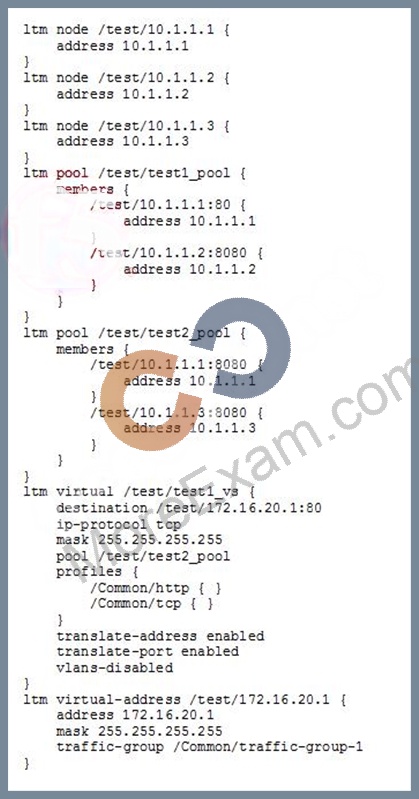
-- Exhibit --
Refer to the exhibit.
An LTM Specialist is reviewing the 'test' partition.
Which objects, in order, can be removed from the partition?
Question100: -- Exhibit -

-- Exhibit -
Refer to the exhibits.
An LTM Specialist uses the information in the logs to determine the cause of a failover event in a high-availability (HA) pair.
What caused the failover?
Question101: A stand-alone LTM device is to be paired with a second LTM device to create an active/standby pair. The current stand-alone LTM device is in production and has several VLANs with floating IP addresses configured.
The appropriate device service clustering (DSC) configurations are in place on both LTM devices.
Which two non-specific DSC settings should the LTM Specialist configure on the second LTM device to ensure no errors are reported when attempting to synchronize for the first time? (Choose two.)
Question102: -- Exhibit -
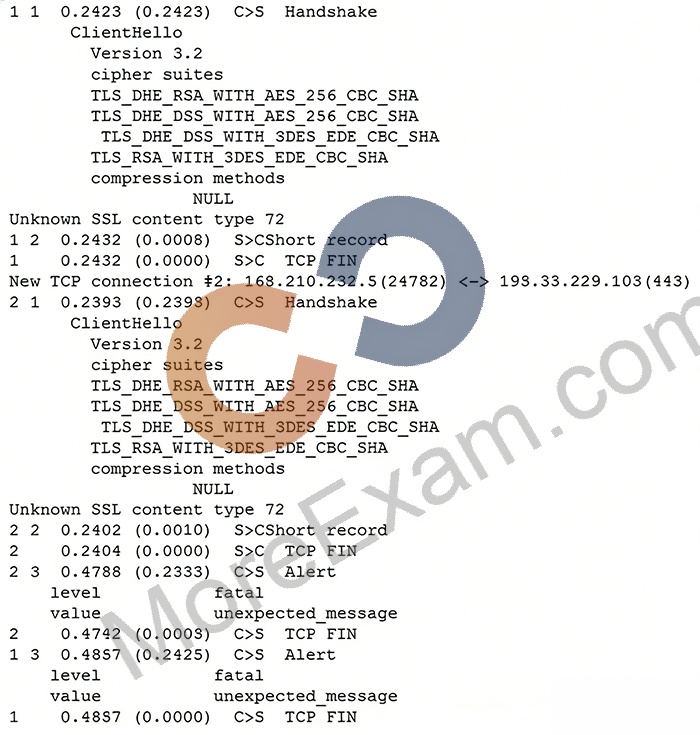
-- Exhibit --
Refer to the exhibit.
A client attempts to connect from a Google Chrome browser to a virtual server on a BIG-IP LTM. The virtual server is SSL Offloaded. When the client connects, the client receives an SSL error. The client receives the same errors when trying Mozilla Firefox and Internet Explorer browsers.
The LTM Specialist does an ssldump on the virtual server and receives the results as per the exhibit.
How should this be resolved?
Question103: -- Exhibit -

-- Exhibit --
Refer to the exhibit.
An LTM Specialist configures a virtual server to load balance to a pool of FTP servers. File transfers are failing. The virtual server is configured as follows:
ltm virtual ftp_vs {
destination 10.10.1.103:ftp
ip-protocol tcp
mask 255.255.255.255
pool ftp_pool
profiles {
tcp { }
}
vlans-disabled
}
Which change will resolve the problem?
Question104: A user is having issues with connectivity to an HTTPS virtual server. The virtual server is on the LTM device's external vlan, and the pools associated with the virtual server are on the internal vlan. An LTM Specialist does a tcpdump on the external interface and notices that the host header is incomplete.
In which location should the LTM Specialist put a traffic analyzer to gather the most pertinent data?
Question105: The end users of a web application need to verify that their browsers received the complete message-body from the web server.
Which HTTP header will accomplish this?
Question106: -- Exhibit- -- Exhibit -

Refer to the exhibit.
An LTM Specialist is troubleshooting an issue with an application configured on an LTM device. The application works properly when accessed directly via the servers; however, it does not work when accessed via the LTM device. The virtual server, 192.168.1.211:443, is configured to SNAT using the address 192.168.1.144 and references a pool with the member 192.168.10.80:443. The virtual server has no Client or Server SSL profiles associated.
Which configuration change will allow the application to function through the virtual server?
Question107: -- Exhibit -

-- Exhibit --
Refer to the exhibit.
A user is unable to access an HTTP application via a virtual server.
What is the cause of the failure?
Question108: Internet clients connecting to a virtual server to download a file are experiencing about 150 ms of latency and no packet loss.
Which built-in client-side TCP profile provides the highest throughput?
Question109: -- Exhibit - -- Exhibit -Refer to the exhibit.

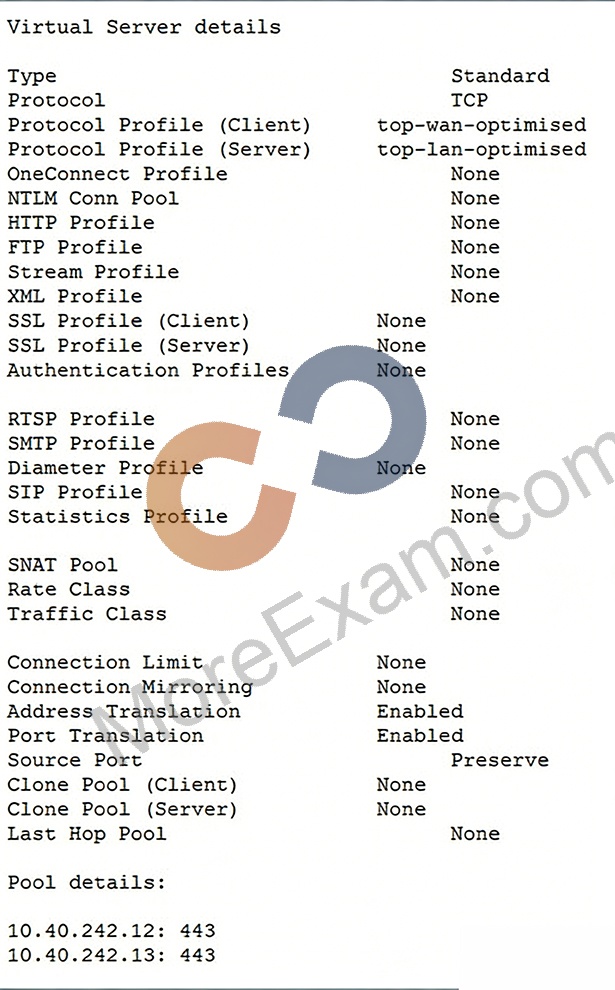
An LTM device is used to load balance web content over a secure channel.
The developers of the web content have done a trace using an HTTP profiler application. They believe that allowing the LTM device to compress traffic to the client will improve performance. The client can utilize GZIP or deflate compression algorithms.
An LTM Specialist must implement the compression.
The LTM Specialist has completed the following actions:
1.Create the relevant profile.
2.Apply the relevant profile to the virtual server (VS).
After applying the relevant profile, the LTM device is failing to compress the traffic. Instead, the traffic is being served with an error.
What is the problem?
Question110: -- Exhibit-

-- Exhibit -
Refer to the exhibit.
An LTM Specialist is investigating reports that users are unable to perform some commands through an FTP virtual server. The users are receiving the FTP error "500 Illegal PORT command." The virtual server is configured to SNAT using automap. The LTM Specialist performs a capture on the server side of the LTM device.
Why is the server returning this error?
Question111: -- Exhibit - -- Exhibit -


Refer to the exhibits.
A customer requests to offload SSL for an internal website. The front page of the website loads correctly; however, selecting links on the page fails.
How should the LTM Specialist fix the issue?
Question112: A failover event is recorded in the following log messages:
Jan 01 00:56:56 BIG-IP notice mcpd[5318]: 01070727:5: Pool /Common/my-pool member / Common/10.0.0.10:80 monitor status down.
Jan 01 00:56:56 BIG-IP notice sod[5855]: 010c0045:5: Leaving active, group score 10 peer group score 20.
Jan 01 00:56:56 BIG-IP notice sod[5855]: 010c0052:5: Standby for traffic group /Common/traffic-group-1.
Jan 01 00:56:56 BIG-IP notice sod[5855]: 010c0018:5: Standby
Jan 01 00:57:06 BIG-IP notice logger: /usr/bin/tmipsecd --tmmcount 4 ==> /usr/bin/bigstart stop racoon What is the cause of the failover?
Question113: An LTM device is running BIG-IP v10.2.0 software. The LTM Specialist is tasked with upgrading the LTM device to BIG-IP v11.2.0 HF1. The LTM Specialist starts the upgrade process by selecting the uploaded Hotfix and installing to an unused volume. After 10 minutes,the LTM Specialist checks the status of the upgrade process and notices that the process is stalled at 0%.
What should the LTM Specialist verify?
Question114: An LTM device has been configured to log the reasons for generating TCP RST packets.
The following log entry occurs:
"01230140:3: RST sent from 192.168.1.100:80 to 192.168.1.124:39272, [0x112d82a:1721] {peer} TCP RST from remote system."
Which condition will trigger this log entry?
Question115: -- Exhibit-

-- Exhibit -
Refer to the exhibit.
A pair of LTM devices are configured for HA. The LTM Specialist observes from a capture that there is a successful connection from a client directly to a web server and an unsuccessful connection from a client via the LTM device to the same web server.
Which two solutions will solve the configuration problem? (Choose two.)
Question116: Windows PC clients are connecting to a virtual server over a high-speed, low-latency network with no packet loss.
Which built-in client-side TCP profile provides the highest throughput for HTTP downloads?
Question117: -- Exhibit -

-- Exhibit --
Refer to the exhibit.
An LTM Specialist is working on an LTM 11.0.0 installation and has identified a security vulnerability as shown in the exhibit. The LTM Specialist is tasked with applying the latest available hotfix to resolve the problem.
Which procedure resolves the problem?
Question118: -- Exhibit -
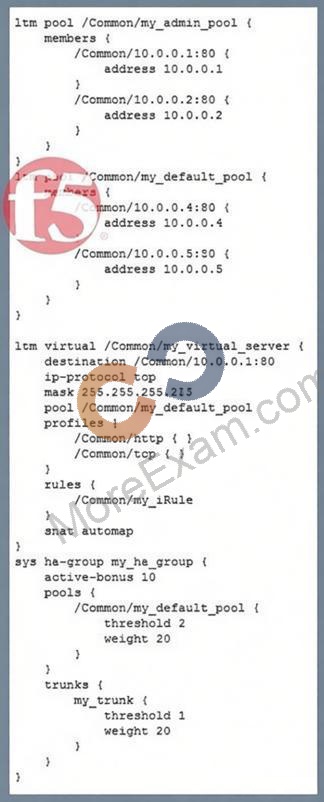
-- Exhibit --
Refer to the exhibit.
A pair of LTM devices is configured for HA.
What happens if the pool member server with IP address 10.0.0.4 becomes totally unresponsive to the active LTM device, but is still responsive to the standby LTM device?
Question119: In which file would the LTM Specialist find virtual server configurations?
Question120: These log entries can have different root causes:
Jun 28 05:01:21 LTM_A notice mcpd[27545]: 0107143a:5: CMI reconnect timer: enabled
Jun 28 05:01:21 LTM_A notice mcpd[27545]: 01071431:5: Attempting to connect to CMI peer
1.1.1.2 port 6699
Jun 28 05:01:21 LTM_A notice mcpd[27545]: 01071432:5: CMI peer connection established to
1.1.1.2 port 6699
Jun 28 05:01:26 LTM_A notice mcpd[27545]: 0107143a:5: CMI reconnect timer: disabled, all peers are connected
Which two commands should be used to obtain additional information on these entries? (Choose two.)
Question121: A web application requires the client to provide the destination server and service identification.
Which HTTP header will supply this information?
Question122: An LTM Specialist needs to rewrite text within an HTML response from a web server. A client is sending the HTTP request below:
GET / HTTP/1.1
Host: www.f5.com
User-Agent: Mozilla/5.0 (Windows NT 6.1; WOW64; rv:16.0) Gecko/20100101 Firefox/16.0 Accept: text/html,application/xhtml+xml,application/xml;q=0.9,*/*;q=0.8 Accept-LanguagE. en-US,en;q=0.5 Accept-EncodinG. gzip, deflate Cache-Control: no-cache Connection: keep-alive CookiE. somecookie=1 Although a stream profile has been added to the virtual server, the content within the HTTP response is NOT being matched, and therefore NOT modified.
Which HTTP header should the LTM Specialist remove from the request to ensure the content can be matched and modified?
Question123: -- Exhibit-


-- Exhibit -
Refer to the exhibits.
An LTM device has been configured for load balancing a number of different application servers. Configuration changes need to be made to the LTM device to allow administrative management of the servers in 172.16.10/24, 172.16.20/24, and 172.16.30/24 networks. The servers require outbound access to numerous destinations for operations.
Which solution has the simplest configuration changes while maintaining functionality and basic security?
Question124: -- Exhibit-


-- Exhibit -
Refer to the exhibits.
How should the LTM Specialist minimize the configuration?
Question125: An LTM Specialist loads a UCS file generated on a different LTM device and receives the following error message:
"mcpd[2395]: 01070608:0: License is not operational (expired or digital signature does not match contents)"
Which command should the LTM Specialist use to prevent the error?
Question126: -- Exhibit-

-- Exhibit --
Refer to the exhibits.
Which URL on which server is causing the highest latency for users?
Question127: -- Exhibit -
-- Exhibit --
Refer to the exhibit.
A client attempts to connect from a Google Chrome browser to a virtual server on a BIG-IP LTM. The virtual server is SSL Offloaded. When the client connects, the client receives an SSL error. After trying Mozilla Firefox and Internet Explorer browsers, the client still receives the same errors.
The LTM Specialist does an ssldump on the virtual server and receives the results as per the exhibit.
What is the problem?
Question128: An LTM Specialist is receiving reports from customers about multiple applications failing to work properly. The LTM Specialist looks at the services running and notices that the bigd process has NOT started.
How are monitored LTM device objects marked when the bigd process is stopped?
Question129: An LTM Specialist has a OneConnect profile and HTTP profile configured on a virtual server to load balance an HTTP application.
The following HTTP headers are seen in a network trace when a client connects to the virtual server:
Clientside:
GET / HTTP/1.1
Host: 192.168.136.100
User-Agent: Mozilla/5.0
Accept: text/html,application/xhtml+xml,application/xml;q=0.9,*/*;q=0.8
Accept-EncodinG. gzip, deflate
Connection: keep-alive
Serverside:
HTTP/1.1 200 OK
DatE. 5 Jun 1989 17:06:55 GMT
Server: Apache/2.2.14 (Ubuntu) Vary: Accept-Encoding
Content-EncodinG. gzip
Content-LengtH. 3729
X-Cnection: close
Content-TypE. text/html
The LTM Specialist notices the OneConnect feature is working incorrectly.
Why is OneConnect functioning incorrectly?
Question130: -- Exhibit - -- Exhibit -Refer to the exhibit.

An LTM Specialist is reviewing the 'test' partition.
Which objects, in order, can be removed from the partition?
Question131: An LTM device has a virtual server configured as a Performance Layer 4 virtual listening on
0.0.0.0:0 to perform routing of packets to an upstream router. The client machine at IP address 192.168.0.4 is attempting to contact a host upstream of the LTM device on IP address 10.0.0.99.
The network flow is asymmetrical, and the following TCP capture displays:
# tcpdump -nnni 0.0 'host 192.168.0.4 and host 10.0.0.99'
tcpdump: verbose output suppressed, use -v or -vv for full protocol decode
listening on 0.0, link-type EN10MB (Ethernet), capture size 96 bytes
05:07:55.499954 IP 192.168.0.4.35345 > 10.0.0.99.443: S 3205656213:3205656213(0) ack 3267995082 win 1480
05:07:55.499983 IP 10.0.0.99.443 > 192.168.0.4.35345: R 1:1(0) ack 1 win 0
05:07:56.499960 IP 192.168.0.4.35345 > 10.0.0.99.443: S 3205656213:3205656213(0) ack 3267995082 win 1480
05:07:56.499990 IP 10.0.0.99.443 > 192.168.0.4.35345: R 1:1(0) ack 1 win 0
4 packets captured
Which option within the fastL4 profile needs to be enabled by the LTM Specialist to prevent the LTM device from rejecting the flow?
Question132: An LTM device pair is configured for failover and connection mirroring. The LTM devices are configured with virtual servers for HTTP, HTTPS with SSL offload, and SSH. An event occurs that causes a failover.
HTTP and SSH sessions active at the time of failover remain active, but HTTPS sessions are dropped.
What is the root cause of this problem?
Question133: -- Exhibit -

-- Exhibit --
Refer to the exhibit.
An LTM Specialist has created a virtual server to load balance traffic to a pool of HTTPS servers. The servers use client certificates for user authentication. The virtual server has clientssl, serverssl, and http profiles enabled. Clients are unable to connect to the application through the virtual server. Clients are able to connect to the application servers directly.
What is the root cause of the problem?
Question134: A high-availability (HA) pair configuration uses only the hardwire serial cable connection to determine device state. A power outage occurs to the PDU powering the active unit. The standby unit takes over the active role as expected.
How is the peer unit able to determine the active unit is unavailable?
Question135: An active/standby pair of LTM devices deployed with network failover are working as desired. After external personnel perform maintenance on the network, the LTM devices are active/active rather than active/standby. No changes were made on the LTM devices during the network maintenance.
Which two actions would help determine the cause of the malfunction? (Choose two.)
Question136: An F5 LTM Specialist needs to perform an LTM device configuration backup prior to RMA swap.
Which command should be executed on the command line interface to create a backup?
Question137: -- Exhibit -
-- Exhibit --
Refer to the exhibit.
An LTM device is used to load balance web content over a secure channel.
The developers of the web content have done a trace using an HTTP profiler application. They believe that allowing the LTM device to compress traffic to the client will improve performance. The client can utilize GZIP or deflate compression algorithms.
An LTM Specialist must implement the compression.
The LTM Specialist has completed the following actions:
1. Create the relevant profile.
2. Apply the relevant profile to the virtual server (VS).
After applying the relevant profile, the LTM device is failing to compress the traffic. Instead, the traffic is being served with an error.
What is the problem?
Question138: An LTM device is load balancing telnet and ssh applications in a client/server environment experiencing significant packet delay.
Which setting in the TCP profile should reduce the amount of packet delay?
Question139: -- Exhibit -

-- Exhibit -Refer to the exhibit. Users report that a web application works incorrectly. Sometimes contextual data displayed on
the web pages is accurate; other times it is inaccurate.
The LTM administrator looks at the connection table with a filter on one of the client IP addresses currently connected using the command "tmsh show sys connection cs-client-addr 10.0.20.1"
with the following results:
10.0.20.1:60048 10.0.20.88:80 10.0.20.1:60048 172.16.20.1:80 tcp 3 (tmm: 0) 10.0.20.1:60050 10.0.20.88:80 10.0.20.1:60050 172.16.20.3:80 tcp 3 (tmm: 0) 10.0.20.1:60047 10.0.20.88:80 10.0.20.1:60047 172.16.20.2:80 tcp 3 (tmm: 0) 10.0.20.1:60049 10.0.20.88:80 10.0.20.1:60049 172.16.20.1:80 tcp 3 (tmm: 0)
What is the solution to the problem?
Question140: -- Exhibit- -- Exhibit -Refer to the exhibit. A client attempts to connect from a Google Chrome browser to a virtual server on a BIG-IP

LTM. The virtual server is SSL Offloaded. When the client connects, the client receives an SSL error. After trying Mozilla Firefox and Internet Explorer browsers, the client still receives the same errors.
The LTM Specialist does an ssldump on the virtual server and receives the results as per the exhibit.
What is the problem?
Question141: -- Exhibit-

-- Exhibit -
Refer to the exhibits.
When observing the AVR statistics for the HTTPS_VS, an LTM Specialist realizes that HTTP status codes are NOT being recorded.
How should the LTM Specialist modify the configuration to record the HTTP status codes?
Question142: -- Exhibit-

-- Exhibit --
Refer to the exhibit.
An LTM Specialist is troubleshooting a sync-failover group of three BIG-IP LTM devices.
The command used is "tmsh run cm watch-devicegroup-device."
What does the output mean?
Question143: The LTM device is configured to provide load balancing to a set of web servers that implement access control lists (ACL) based on the source IP address of the client. The ACL is at the network level and the web server is configured to send a TCP reset back to the client if it is NOT permitted to connect.
The virtual server is configured with the default OneConnect profile.
The ACL is defined on the web server as:
Permit: 192.168.136.0/24
Deny: 192.168.116.0/24
The packet capture is taken of two individual client flows to a virtual server with IP address
192.168.136.100.
Client A - Src IP 192.168.136.1 - Virtual Server 192.168.136.100:
Clientside:
09:35:11.073623 IP 192.168.136.1.55684 > 192.168.136.100.80: S 869998901:869998901(0) win 8192
<mss 1460,nop,wscale 2,nop,nop,sackOK>
09:35:11.073931 IP 192.168.136.100.80 > 192.168.136.1.55684: S 2273668949:2273668949(0) ack
869998902 win 4380 <mss 1460,nop,wscale 0,sackOK,eol>
09:35:11.074928 IP 192.168.136.1.55684 > 192.168.136.100.80: . ack 1 win 16425
09:35:11.080936 IP 192.168.136.1.55684 > 192.168.136.100.80: P 1:299(298) ack 1 win 16425
09:35:11.081029 IP 192.168.136.100.80 > 192.168.136.1.55684: . ack 299 win 4678 Serverside:
09:35:11.081022 IP 192.168.136.1.55684 > 192.168.116.128.80: S 685865802:685865802(0) win 4380
<mss 1460,nop,wscale 0,sackOK,eol>
09:35:11.081928 IP 192.168.116.128.80 > 192.168.136.1.55684: S 4193259095:4193259095(0) ack
685865803 win 5840 <mss 1460,nop,nop,sackOK,nop,wscale 6>
09:35:11.081943 IP 192.168.136.1.55684 > 192.168.116.128.80: . ack 1 win 4380
09:35:11.081955 IP 192.168.136.1.55684 > 192.168.116.128.80: P 1:299(298) ack 1 win 4380
09:35:11.083765 IP 192.168.116.128.80 > 192.168.136.1.55684: . ack 299 win 108 Client B - Src IP 192.168.116.1 - Virtual Server 192.168.136.100:
Clientside:
09:36:11.244040 IP 192.168.116.1.55769 > 192.168.136.100.80: S 3320618938:3320618938(0) win 8192
<mss 1460,nop,wscale 2,nop,nop,sackOK>
09:36:11.244152 IP 192.168.136.100.80 > 192.168.116.1.55769: S 3878120666:3878120666(0) ack
3320618939 win 4380 <mss 1460,nop,wscale 0,sackOK,eol>
09:36:11.244839 IP 192.168.116.1.55769 > 192.168.136.100.80: . ack 1 win 16425
09:36:11.245830 IP 192.168.116.1.55769 > 192.168.136.100.80: P 1:299(298) ack 1 win 16425
09:36:11.245922 IP 192.168.136.100.80 > 192.168.116.1.55769: . ack 299 win 4678 Serverside:
09:36:11.245940 IP 192.168.136.1.55684 > 192.168.116.128.80: P 599:897(298) ack 4525 win 8904
09:36:11.247847 IP 192.168.116.128.80 > 192.168.136.1.55684: P 4525:5001(476) ack 897 win 142 Why was the second client flow permitted by the web server?
Question144: -- Exhibit -

-- Exhibit -Refer to the exhibit.
The decoded TCPDump capture is a trace of a failing health monitor. The health monitor is sending the string shown in the capture; however, the server response is NOT as expected. The receive string is set to 'SERVER IS UP'.
What is the solution?
Question145: An LTM Specialist loads a UCS file generated on a different LTM device and receives the following error message:
"mcpd[2395]: 01070608:0: License is not operational (expired or digital signature does not match contents)" Which command should the LTM Specialist use to prevent the error?
Question146: -- Exhibit-

-- Exhibit -Refer to the exhibit.
An HTTP monitor always marks the nodes in the pool as down. The monitor's definition and the HTTP headers from the monitor request and response are provided.
What is the issue?
Question147: -- Exhibit-

-- Exhibit -
Refer to the exhibits.
An LTM Specialist uses the information in the logs to determine the cause of a failover event in a high-availability (HA) pair.
What caused the failover?
Question148: An LTM Specialist defines a receive string in the HTTP monitor and then assigns it to the HTTP pool. The monitor has an interval of 5 seconds and a timeout of 16 seconds.
If the receive string is NOT seen in the the HTTP payload after 20 seconds, how does the LTM device mark the monitor status?
Question149: An LTM Specialist must perform a packet capture on a virtual server with an applied standard FastL4 profile. The virtual server 10.0.0.1:443 resides on vlan301.
Which steps should the LTM Specialist take to capture the data payload successfully while ensuring no other virtual servers are affected?
Question150: -- Exhibit-
-- Exhibit -
Refer to the exhibit.
An LTM Specialist has created a virtual server to load balance traffic to a pool of HTTPS servers. The servers use client certificates for user authentication. The virtual server has clientssl, serverssl, and http profiles enabled. Clients are unable to connect to the application through the virtual server. Clients are able to connect to the application servers directly.
What is the root cause of the problem?
Question151: An LTM Specialist is creating a custom EAV monitor.
In which directory should the LTM Specialist upload the script?
Question152: The LTM Specialist is writing a custom HTTP monitor for a web application and has viewed the content by accessing the site directly via their browser. The monitor continually fails. The monitor configuration is:
ltm monitor http /Common/exampleComMonitor {
defaults-from /Common/http
destination *:*
interval 5
recv "Recent Searches"
send "GET /app/feed/current\?uid=20145 HTTP/1.1\\r\\nHost:
www.example.com\\r\\nAccept-EncodinG.gzip, deflate\\r\\nConnection: close\\r\\n\\r\\n"
time-until-up 0
timeout 16
}
A trace shows the following request and response:
Request:
GET /app/feed/current?uid=20145 HTTP/1.1
Host www.example.com
Accept-Encoding gzip, deflate
Connection: close
Response: HTTP/1.1 302 Moved Temporarily Date Wed, 17 Oct 2012 18:45:52 GMT Server Apache Location https://example.com/login.jsp Content-Encoding gzip Content-Type text/html;charset=UTF-8 Set-CookiE.JSESSIONID=261EFFBDA8EC3036FBCC22D991AC6835;
Path=/app/feed/current?uid=20145
What is the problem?
Question153: An LTM Specialist realizes that a datacenter engineer has changed the console baud rate.
Which command determines the current baud rate via the command line interface?
Question154: An LTM Specialist is troubleshooting a problem on an eCommerce website. The user browses the online store using port 80, adding items to the shopping cart. The user then clicks the "Checkout" button on the site, which redirects the user to port 443 for the checkout process. Suddenly, the user's shopping cart is shown as empty.
The shopping cart data is stored in memory on the server, and the default source address persistence profile is used on both virtual servers.
How should the LTM Specialist resolve this issue?
Question155: -- Exhibit - -- Exhibit -

Refer to the exhibits.
Which two servers are missing two frequently used URLs? (Choose two.)
Question156: An LTM Specialist has set up a custom SNMP alert.
Which command line tool should the LTM Specialist use to test the alert?
Question157: An LTM Specialist is troubleshooting an HTTP monitor. The pool member is accessible directly through a browser, but the HTTP monitor is marking the pool member as down.
GET / HTTP/1.1
HTTP/1.1 400 Bad Request DatE.Tue, 23 Oct 2012 21:39:07 GTM Server: Apache/2.2.22 (FreeBSD) PHP/5.4.4 mod_ssl/2.2.22 OpenSSL/0.9.8q DAV/2 Content-LengtH.226
Connection: close
Content-TypE.text/html; charset=iso-8859-1
How should the LTM Specialist resolve this issue?
Question158: -- Exhibit- -- Exhibit -

Refer to the exhibit.
An LTM Specialist is reviewing the 'test' partition.
Which objects, in order, can be removed from the partition?
Question159: Which file should be modified to create custom SNMP alerts?
Question160: An LTM Specialist receives a request to monitor the network path through a member, but NOT the member itself.
Which monitor option should the LTM Specialist enable or configure?
Question161: An LTM Specialist is working with an LTM device configured with 10 virtual servers on the same domain with a different key/cert pair per virtual. For examplE.www.example.com; ftp.example.com; ssh.example.com; ftps.example.com.
What should the LTM Specialist do to reduce the number of objects on the LTM device?
Question162: An LTM device is monitoring three pool members. One pool member is being marked down.
What should the LTM Specialist enable to prevent the server from being flooded with connections once its monitor determines it is up?
Question163: An LTM Specialist is running the following packet capture on an LTM device:
ssldump -Aed -ni vlan301 'port 443'
Which two SSL record message details will the ssldump utility display by default? (Choose two.)
Question164: A device group is made up of four members: LTM-A, LTM-B, LTM-C, and LTM-D. An LTM Specialist makes a configuration change on LTM-B. Later, a different LTM Specialist notices a "changes pending" message on all devices. When logged into LTM-D, the LTM Specialist attempts to config-sync to the device group. The sync operation fails.
Why is the LTM Specialist on LTM-D unable to synchronize the configuration to the group?
Question165: An LTM Specialist has installed a hotfix that updated the SCCP firmware package.
Which command will ensure that the host subsystem and SCCP reboot?
Question166: A device group is made up of four members: LTM-A, LTM-B, LTM-C, and LTM-D. An LTM Specialist makes a configuration change on LTM-B. Later, a different LTM Specialist notices a "changes pending" message on all devices. When logged into LTM-D, the LTM Specialist attempts to config-sync to the device group. The sync operation fails.
Why is the LTM Specialist on LTM-D unable to synchronize the configuration to the group?
Question167: -- Exhibit-

-- Exhibit --
Refer to the exhibit.
Which step should an LTM Specialist take to utilize AVR?
Question168: -- Exhibit-

-- Exhibit -Refer to the exhibit. An LTM Specialist has created a virtual server to balance connections to a pool of
application servers and offload SSL decryption. Clients connect to the application at https://www.example.com/. The virtual server is configured with a clientssl profile but no serverssl profile. The application servers are listening on ports 80 and 443. Users are unable to connect to the application through the virtual server but are able to connect directly to the application server.
What is the root cause of the error?
Question169: An IT administrator wants to log which server is being load balanced to by a user with IP address 10.10.10.25.
Which iRule should the LTM Specialist use to fulfill the request?
Question170: -- Exhibit -
-- Exhibit --
Refer to the exhibit.
Which two items can be consolidated to simplify the LTM configuration? (Choose two.)
Question171: An LTM Specialist has configured a virtual server for www.example.com, load balancing connections to a pool of application servers that provide a shopping cart application. Cookie persistence is enabled on the virtual server. Users are able to connect to the application, but the user's shopping cart fails to update. A traffic capture shows the following:
Request: GET /cart/updatecart.php HTTP/1.1 Host: www.example.com Connection: keep-alive Cache-Control: max-age=0 User-Agent: Mozilla/5.0 (Macintosh; Intel Mac OS X 10_7_5) AppleWebKit/537.4 (KHTML,
like Gecko) Chrome/22.0.1229.94 Safari/537.4 Accept: text/html,application/xhtml+xml,application/xml;q=0.9,*/*;q=0.8 Accept-EncodinG.gzip,deflate,sdch Accept-LanguagE.en-US,en;q=0.8 Accept-Charset: ISO-8859-1,utf-8;q=0.7,*;q=0.3 CookiE.BIGipServerwebstore_pool=353636524.20480.0000
Response:
HTTP/1.1 200 OK
DatE.Wed, 24 Oct 2012 18:00:13 GMT
Server: Apache/2.2.22 (Ubuntu)
X-Powered-By: PHP/5.3.10-1ubuntu3.1
Set-CookiE.cartID=647A5EA6657828C69DB8188981CB5; path=/;
domain=wb01.example.com
Keep-AlivE.timeout=5, max=100
Connection: Keep-Alive
Content-TypE.text/html
No changes can be made to the application.
What should the LTM Specialist do to resolve the problem?
Question172: -- Exhibit -

-- Exhibit --
Refer to the exhibit.
An LTM Specialist has uploaded a qkview to F5 iHealth.
Within the GUI, what is the correct procedure to comply with the recommendation shown in the
exhibit?
Question173: -- Exhibit-

-- Exhibit -
Refer to the exhibit.
An LTM Specialist is performing an HTTP trace on the client side of the LTM device and notices there are many undesired headers being sent by the server in the response. The LTM Specialist wants to remove all response headers except "Set-Cookie" and "Location."
How should the LTM Specialist modify the HTTP profile to remove undesired headers from the HTTP response?
Question174: An LTM Specialist with the Administrator role and terminal access of "tmsh" logs in via ssh and is in the Traffic Manager Shell. The LTM Specialist wants to enter the bash shell to review log files.
Which command does the LTM Specialist need to run to access the bash shell?
Question175: An LTM device is deployed in a one-armed topology. The virtual server, clients, and web servers are connected on the LTM device internal VLAN. A client tries to connect to the virtual server and is unable to establish a connection. A packet capture from the LTM device internal VLAN shows that the HTTP request is being forwarded to the web server.
From which two additional locations should protocol analyzer data be collected? (Choose two.)
Question176: -- Exhibit -

-- Exhibit --
Refer to the exhibit.
An LTM Specialist is reviewing the 'test' partition.
Which objects, in order, can be removed from the partition?
Question177: Which iRule statement demotes a virtual server from CMP?
Question178: An LTM Specialist has a OneConnect profile and HTTP profile configured on a virtual server to load balance an HTTP application.
The following HTTP headers are seen in a network trace when a client connects to the virtual server:
Clientside: GET / HTTP/1.1 Host: 192.168.136.100 User-Agent: Mozilla/5.0 Accept: text/html,application/xhtml+xml,application/xml;q=0.9,*/*;q=0.8 Accept-EncodinG.gzip, deflate Connection: keep-alive
Serverside: HTTP/1.1 200 OK DatE.5 Jun 1989 17:06:55 GMT Server: Apache/2.2.14 (Ubuntu) Vary: Accept-Encoding Content-EncodinG.gzip Content-LengtH.3729 X-Cnection: close
Content-TypE.text/html
The LTM Specialist notices the OneConnect feature is working incorrectly.
Why is OneConnect functioning incorrectly?
Question179: -- Exhibit -

-- Exhibit -
Refer to the exhibit.
An LTM Specialist is troubleshooting an HTTP monitor that is marking a pool member as down. Connecting to the pool member directly through a browser shows the application is up and functioning correctly.
How should the send string be modified to correct this issue?
Question180: -- Exhibit -

-- Exhibit --
Refer to the exhibit.
Based on the output of the tmsh interface show command, what is the issue?
Question181: Users are experiencing low throughput when downloading large files over a high-speed WAN connection.
Extensive packet loss was found to be an issue but CANNOT be eliminated.
Which two TCP profile settings should be modified to compensate for the packet loss in the network?
(Choose two.)
Question182: An LTM Specialist has configured a virtual server for www.example.com, load balancing connections to a pool of application servers that provide a shopping cart application. Cookie persistence is enabled on the virtual server. Users are able to connect to the application, but the user's shopping cart fails to update. A traffic capture shows the following:
Request: GET /cart/updatecart.php HTTP/1.1 Host: www.example.com Connection: keep-alive Cache-Control: max-age=0 User-Agent: Mozilla/5.0 (Macintosh; Intel Mac OS X 10_7_5) AppleWebKit/537.4 (KHTML, like
Gecko) Chrome/22.0.1229.94 Safari/537.4 Accept: text/html,application/xhtml+xml,application/xml;q=0.9,*/*;q=0.8 Accept-EncodinG. gzip,deflate,sdch Accept-LanguagE. en-US,en;q=0.8 Accept-Charset: ISO-8859-1,utf-8;q=0.7,*;q=0.3 CookiE. BIGipServerwebstore_pool=353636524.20480.0000
Response: HTTP/1.1 200 OK DatE. Wed, 24 Oct 2012 18:00:13 GMT Server: Apache/2.2.22 (Ubuntu) X-Powered-By: PHP/5.3.10-1ubuntu3.1 Set-CookiE. cartID=647A5EA6657828C69DB8188981CB5; path=/; domain=wb01.example.com Keep-AlivE. timeout=5, max=100 Connection: Keep-Alive Content-TypE. text/html
No changes can be made to the application.
What should the LTM Specialist do to resolve the problem?
Question183: -- Exhibit -


-- Exhibit -
Refer to the exhibits.
How should the LTM Specialist minimize the configuration?
Question184: -- Exhibit-

-- Exhibit --
Refer to the exhibit.
A user is unable to access an application.
What is the root cause of the problem?
Question185: -- Exhibit - -- Exhibit -

Refer to the exhibit.
An LTM Specialist configures a virtual server that balances HTTP connections to a pool of three application servers. Approximately one out of every three connections to the virtual server fails.
Which two actions will resolve the problem? (Choose two.)
Question186: -- Exhibit -

-- Exhibit --
Refer to the exhibit.
A layer 2 nPath routing configuration has been deployed. A packet capture contains a client connection packet with the following properties:
Source IP: <Virtual Server>
Destination IP: <Client A>
At which two locations could the packet capture have been taken? (Choose two.)
Question187: An LTM Specialist is investigating reports from users that SSH connections are being terminated unexpectedly. SSH connections are load balanced through a virtual server. The users experiencing this problem are running SQL queries that take upwards of 15 minutes to return with no screen output. The virtual server is standard with a pool associated and no other customizations.
What is causing the SSH connections to terminate?
Question188: An LTM device supports two power supplies. The value of the BigDB key "platform.powersupplymonitor" is equal to enable.
Where would the error message be visible if one of the power supplies fails or is NOT plugged in?
Question189: An LTM Specialist has been asked to configure a virtual server to distribute connections between a pool of two application servers with addresses 172.16.20.1 and 172.16.20.2. The application servers are listening on TCP ports 80 and 443. The application administrators have asked that clients be directed to the same node for both HTTP and HTTPS requests within the same session.
Virtual servers vs_http and vs_https have been created, listening on 1.2.3.100:80 and 1.2.3.100:443, respectively.
Which configuration option will result in the desired behavior?
Question190: -- Exhibit -


-- Exhibit -
Refer to the exhibits.
When observing the AVR statistics for the HTTPS_VS, an LTM Specialist realizes that HTTP status codes are NOT being recorded.
How should the LTM Specialist modify the configuration to record the HTTP status codes?
Question191: -- Exhibit -

-- Exhibit -
Refer to the exhibit.
An LTM Specialist configures a virtual server to load balance to a pool of FTP servers. File transfers are failing. The virtual server is configured as follows:
ltm virtual ftp_vs { destination 10.10.1.103:ftp ip-protocol tcp mask 255.255.255.255 pool ftp_pool profiles { tcp { } } vlans-disabled
}
Which change will resolve the problem?
Question192: The output of a tmsh command is:-----------------------------------------------------------Net::Interface Name Status Bits Bits Errs Errs Drops Drops Colli In Out In Out In Out sions ------------------------------------------------------------ 1.1 down 0 0 0 0 0 0 0 1.2 up 191.4K 0 0 0 374 0 0 1.3 down 0 0 0 0 0 0 0 1.4 up 22.5K 0 0 0 44 0 0 2.1 miss 0 0 0 0 0 0 0 2.2 miss 0 0 0 0 0 0 0 mgmt up 43.2G 160.0G 0 0 0 0 0
Which command was executed on the LTM device to show the output?
Question193: -- Exhibit - -- Exhibit -


Refer to the exhibits.
Users are able to access the application when connecting to the virtual server but are unsuccessful when connecting directly to the application servers. The LTM Specialist wants to allow direct access to the application servers.
Why are users unable to connect directly to the application servers?
Question194: -- Exhibit -
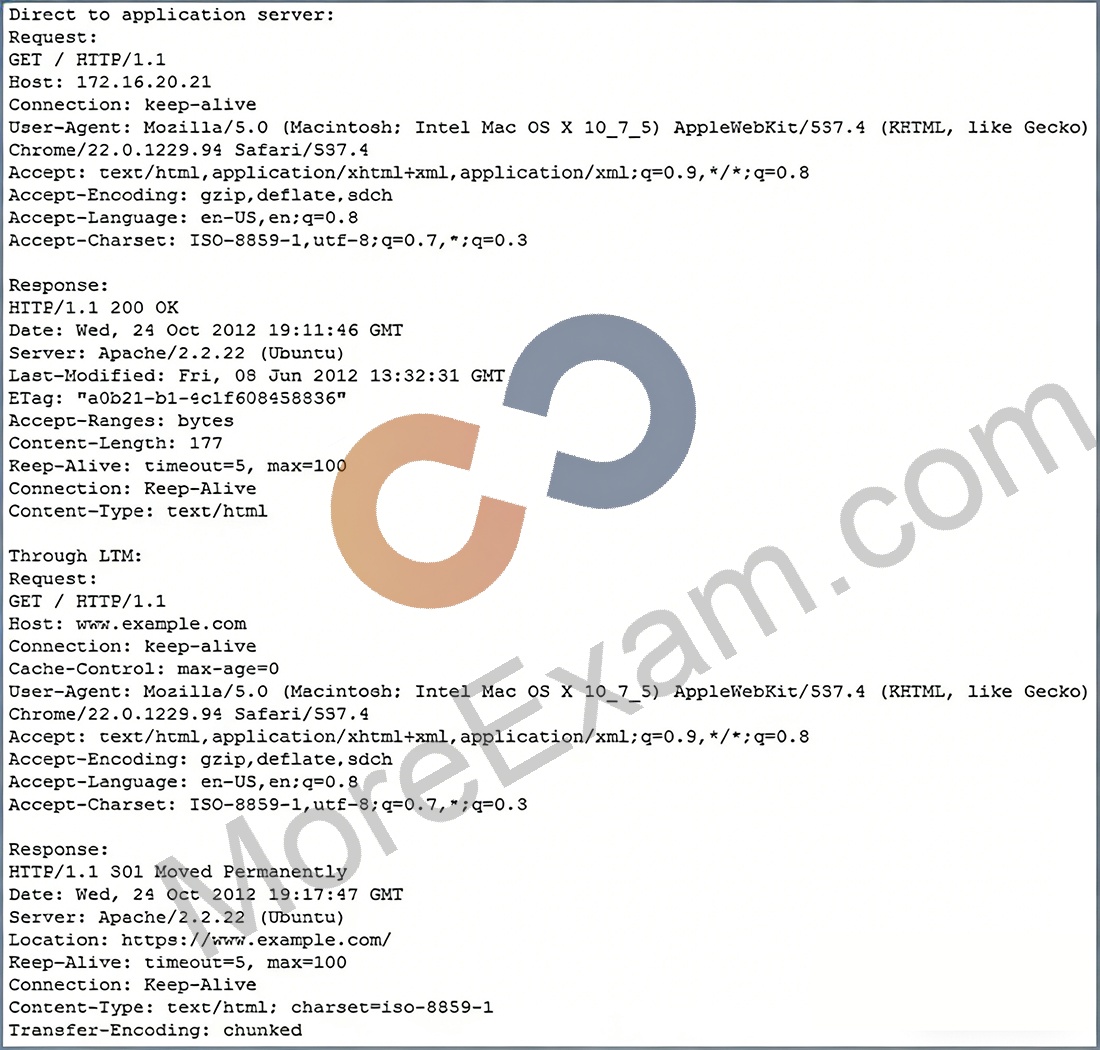
-- Exhibit --
Refer to the exhibit.
An LTM Specialist has created a virtual server to balance connections to a pool of application servers and offload SSL decryption. Clients connect to the application at https://www.example.com/. The virtual server is configured with a clientssl profile but no serverssl profile. The application servers are listening on ports
80 and 443. Users are unable to connect to the application through the virtual server but are able to connect directly to the application server.
What is the root cause of the error?
Question195: Users in a branch office are reporting a website is always slow. No other users are experiencing the problem. The LTM Specialist tests the website from the external VLAN along with testing the servers directly. All tests indicate normal behavior. The environment is a single HTTP virtual server on the external VLAN with a single pool containing three HTTP pool members on the internal VLAN.
Which two locations are most appropriate to collect additional protocol analyzer data? (Choose two.)
Question196: -- Exhibit -


-- Exhibit --
Refer to the exhibits.
Users are able to access the application when connecting to the virtual server but are unsuccessful when connecting directly to the application servers. The LTM Specialist wants to allow direct access to the application servers.
Why are users unable to connect directly to the application servers?
Question197: Given this as the first packet displayed of an ssldump:
2 2 1296947622.6313 (0.0001) S>CV3.1(74) Handshake
ServerHello
Version 3.1
random[32]
19 21 d7 55 c1 14 65 63 54 23 62 b7 c4 30 a2 f0
b8 c4 20 06 86 ed 9c 1f 9e 46 0f 42 79 45 8a 29
session_id[32]
c4 44 ea 86 e2 ba f5 40 4b 44 b4 c2 3a d8 b4 ad
4c dc 13 0d 6c 48 f2 70 19 c3 05 f4 06 e5 ab a9
cipherSuite TLS_RSA_WITH_RC4_128_SHA
compressionMethod NULL
In reviewing the rest of the ssldump, the application data is NOT being decrypted.
Why is ssldump failing to decrypt the application data?
Question198: -- Exhibit-

-- Exhibit -
Refer to the exhibits.
After upgrading LTM from v10 to v11, users are unable to connect to an application. The virtual server is using a client SSL profile for re-terminating SSL for payload inspection, but a server SSL profile is being used to re-encrypt the request.
A client side ssldump did NOT show any differences between the traffic going directly to the server and the traffic being processed by the LTM device. However, packet capture was done on the server, and differences were noted.
Which modification will allow the LTM device to process the traffic correctly?
Question199: An LTM Specialist has just captured trace /var/tmp/trace.cap for site www.example.com while listening on virtual address 10.0.0.1:443 configured on partition ApplicationA. The data payload being captured is SSL encrypted.
Which command should the LTM Specialist execute to decrypt the data payload?
Question200: An LTM Specialist must perform a hot fix installation from the command line.
What is the correct procedure to ensure that the installation is successful?
Question201: An LTM Specialist troubleshooting an issue looks at the following /var/log/ltm entries:
Oct 2 04:52:42 slot1/tmm7 crit tmm7[21734]: 01010201:2: Inet port exhaustion on 10.143.109.5 to
10.143.147.150:53
(proto 17)
Oct 2 05:37:16 slot1/tmm7 crit tmm7[21734]: 01010201:2: Inet port exhaustion on 10.143.109.5 to
10.143.147.150:53
(proto 17)
Oct 2 05:57:32 slot1/tmm2 crit tmm2[21729]: 01010201:2: Inet port exhaustion on 10.143.109.5 to
10.143.147.150:53
(proto 17)
Oct 2 06:30:03 slot1/tmm7 crit tmm7[21734]: 01010201:2: Inet port exhaustion on 10.143.109.5 to
10.143.147.150:53
(proto 17)
Oct 2 06:37:44 slot1/tmm2 crit tmm2[21729]: 01010201:2: Inet port exhaustion on 10.143.109.5 to
10.143.147.150:53
(proto 17)
Oct 2 06:47:05 slot1/tmm5 crit tmm5[21732]: 01010201:2: Inet port exhaustion on 10.143.109.5 to
10.143.147.150:53
(proto 17)
Which configuration item should the LTM Specialist review to fix the issue?